There is currently a great deal of war-related noise, with colossal state budgets poured into new weapons such as aircraft, drones, aircraft carriers, missiles, and so on. Yet there is an invisible, far more subtle war being waged at the very level of the human mind.
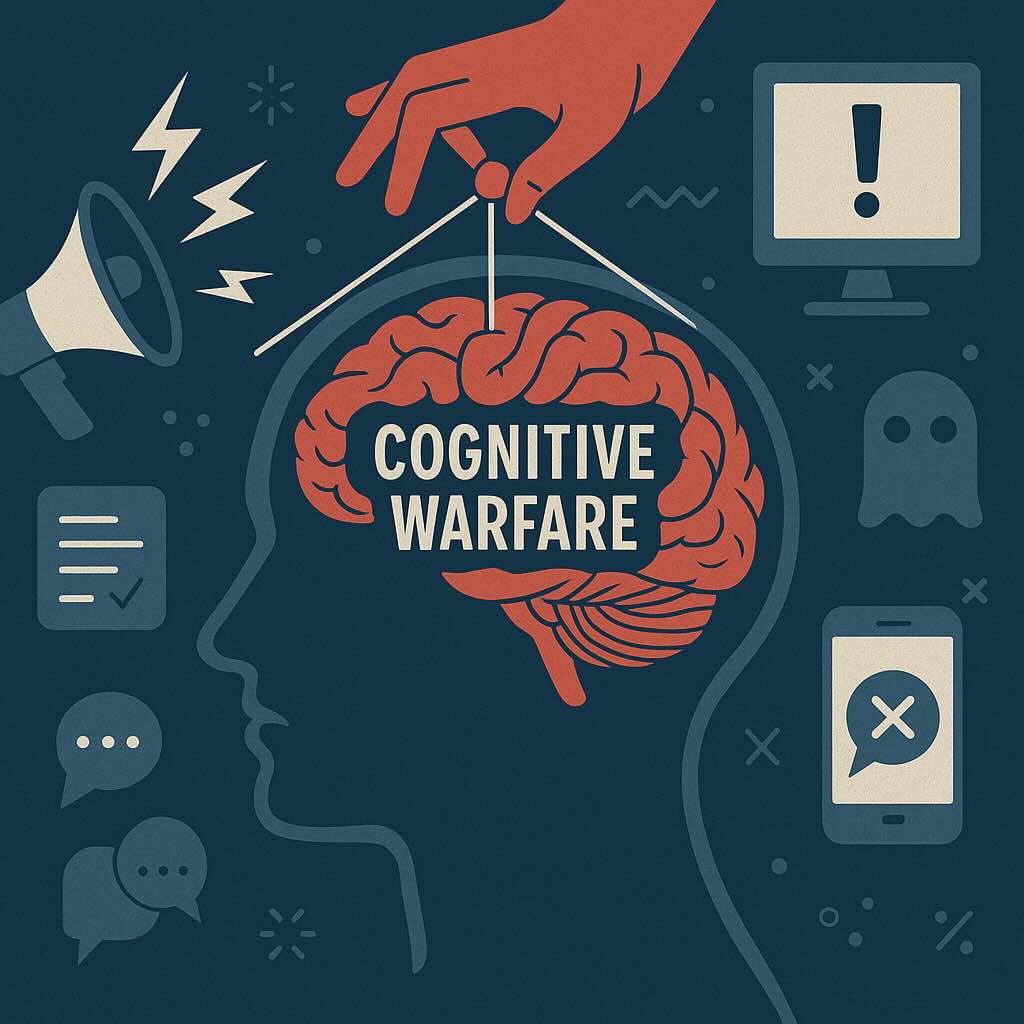
The human mind is like the captain of a ship. It gives direction and takes decisions. Victory therefore no longer plays out on a battlefield, but truly at the heart of our mental processes. How is this possible? Quite simply because we are now in the age of the information society. We are in fact flooded with information, and this information has an impact on the way we see the world and the way we make decisions.
We can now speak of cognitive warfare, a term that is not well known, mainly used in military and geopolitical spheres. It designates a new dimension of modern conflicts, where the aim is no longer merely to dominate through military, economic or informational power, but to act directly on the perceptions, emotions and cognitive capacities of individuals and societies.
Let us look at what cognitive warfare is, how it can become an issue within psychosocial risks, and how we can strengthen ourselves as warriors in this little-discussed war.
I. What is cognitive warfare?
1. Definition
Cognitive warfare is the set of techniques and strategies aimed at influencing, manipulating, disrupting or controlling human mental processes (perceptions, judgements, memory, emotions, behaviours) in order to gain advantage in a conflict. It is sometimes described as a weapon of the brain, because the battlefield becomes the human psyche itself.
2. Origins and context
It stands in continuity with psychological warfare and information warfare (propaganda, fake news, cyber-influence). Advances in neuroscience, AI, big data and the behavioural sciences now offer new tools to target individuals and crowds. Institutions such as NATO or certain think tanks now speak of "cognitive warfare" as a sixth domain of warfare (after land, sea, air, space and cyberspace).
3. Means used
Disinformation and propaganda: massive use of social networks, deepfakes, fake news.
Psychological micro-targeting: exploiting personal data to send ultra-targeted messages tailored to personality and emotions.
Over-information and confusion: drowning the public in a contradictory flow to weaken its ability to discern truth from falsehood.
Exploitation of cognitive biases: storytelling, shocking images, repetition, polarisation.
Emerging technologies: conversational AIs, bots, augmented/virtual reality, and even military research into the impact of neuro-technological signals.
4. Objectives
– Destabilise trust: in institutions, the media, science, democracy.
– Divide societies: polarise opinion, create internal fractures.
– Influence decisions: electoral, economic, diplomatic.
– Weaken an adversary's will to resist without firing a single shot.
5. Current examples
– Disinformation campaigns related to the Covid-19 pandemic.
– Use of troll armies and bot farms in conflicts (Ukraine, Syria, Taiwan, etc.).
– Electoral influence through micro-targeting (e.g., the Cambridge Analytica case).
– Proliferation of deepfakes in politics and the media.
6. Ethical and societal issues
– Risk of mass manipulation and loss of individual autonomy.
– Fragilisation of democracies in the face of authoritarian regimes.
– Moral dilemma: how far can psychology and neuroscience be used as weapons?
– The need to educate for critical thinking and cognitive resilience (media literacy, philosophy, soft skills).
II. Difference between information warfare, psychological warfare and cognitive warfare
Act on emotions
Ancient practice. Propaganda, rumours, fear. Target: emotions (fear, hope, anger).
Act on data
Digital era. Fake news, media manipulation, cyber-attacks. Target: information flows.
Act on thought itself
NATO's 6th domain of warfare. Neuroscience, AI, deepfakes. Target: the brain's capacity to reason and decide.
– Psychological: act on emotions.
– Informational: act on data and the media environment.
– Cognitive: act on internal mechanisms of thought.
Cognitive warfare is the culmination of the other two, integrating technology, neuroscience and artificial intelligence.
III. Psychosocial risk for organisations
Employees are exposed to a constant flow of contradictory information (emails, social networks, news). This over-information can generate stress, mental fatigue and a loss of discernment, making decision-making at work difficult.
Disinformation campaigns can create fear, anger or mistrust towards the organisation, colleagues or hierarchy. Internal trust erodes, which harms team cohesion and cooperation.
If manipulated messages circulate (on social, political or health issues), they can divide employees according to their beliefs. This fosters interpersonal conflict and weakens the social climate.
Continuous exposure to anxiety-inducing or misleading content can provoke anxiety, a sense of insecurity, even emotional exhaustion. This increases the risks of burnout or psychological distress.
If employees doubt the reliability of information (internal or external), this creates a feeling of disorientation and loss of bearings. They may disengage, lose motivation and develop cynicism towards the organisation.
Cognitive-warfare techniques (fake news, deepfakes, trolls) can target not only the organisation but also individuals. An employee attacked online may suffer digital harassment that affects both professional and personal balance.
IV. Individual defence strategies
Develop critical thinking: Check sources before sharing information. Ask simple questions: Who is speaking? In whose interest? Can it be verified elsewhere?
Limit exposure to information bubbles: Vary sources (media, countries, languages, points of view). Beware of social-media algorithms that reinforce polarisation.
Recognise your cognitive biases: Example: confirmation bias (seeking what confirms our ideas). Being aware of them already reduces their manipulative power.
Manage your emotions: Cognitive warfare often targets fear, anger or indignation. Take a step back before reacting.